


Foreigners sign up to support China's Olympic bid
World Cup offers `laowai `golden opportunity to net ultimate goal
Laowai loves China
Foreigners sign up to support China's Olympic bid |
|
By D. Casey Flaherty, July 16, 2001 |
|

LaoWai-古乐言
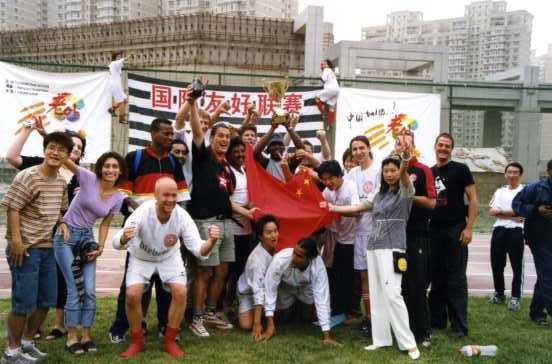
An assemblage of foreigners enthusiastically yell !0 Beijing zhu ni cheng gong!0 (Beijing, we wish you success)! The group shows off their Chinese skills as they pose for the cameras, much to the delight of the Chinese Press. After all, anything to do with the Beijing's Olympic bid is big news.
Foreigners sign up to support China's Olympic bid
By D. Casey Flaherty
An assemblage of foreigners enthusiastically yell "Beijing zhu ni cheng gong" (Beijing, we wish you success)! The group shows off their Chinese skills as they pose for the cameras, much to the delight of the Chinese Press. After all, anything to do with the Beijing's Olympic bid is big news.
Quite a motley crew, they come from around the globe. Whether they hail from Mali or the Ukraine, they are collectively known as "Lao Wai". In this case, the term is a self-styled handle and is no longer just the standard term for people who originate from outside the Middle Kingdom. Lao Wai is now an organization that's purpose is to support Beijing with the Olympic bid. A book of over 12,000 signatures, eventually destined for the International Olympic Committee, is the central part of Lao Wai's campaign to help Beijing win the coveted 2008 Olympic bid.
"We are non-political, and non-corporate", explains Guido Rosler, the German co-founder of Lao Wai and its organizational center. "We want to bring the 2008 Olympics to Beijing. We live here. For many of us Beijing is our home. We want to show the rest of the world how much we appreciate China. We want them to see what happens when you take a closer look. We also want the Chinese people to know that we support them - that we are not simply here to make money." Beijing has been home to Guido for several years now, and he is the organization's coordinator, picking the locations and arranging for transportation as well as recruiting anyone he can to help collect signatures.
The group recently staged its final event. Hanging their symbol over a bridge at the New Summer Palace, Lao Wai opened a huge book, composed solely of signatures. The book spanned the entire length of the bridge. Over the past 3 months, Lao Wai members had stationed themselves outside tourist havens such as the Forbidden City, the Silk Market, and the Great Wall, specifically approaching the foreign community, asking them to sign. Although Chinese signatures were accepted, the group's international focus made the foreign signatures a priority. Lao Wai gathered signatures from over 100 countries.
Lao Wai feels compelled to send a message: "It's a great thing for Beijing", says the other founder, Pawel Matolwicz, of Poland. "It will help the city develop faster. It is wonderful for the city. It is nice for me because I can see myself living my whole life here. We chose the bridge as our symbol. We want to be a bridge between the ordinary people of China and the ordinary people of the rest of the world. The Olympics are the games for ordinary people who do extraordinary things. We want the Chinese to know that we support them in their bid".
Most of Lao Wai's members are students at Beijing University of Language and Culture. They share Pawel's sentiments: "I will not be here for the Olympics, but since I have come to China the people have been so friendly, so kind, so warm that I want them to know we care about Beijing", says John, 20, from Mali. John and his fellow members have spent hours requesting signatures. But not everybody signs.
It is easy to understand why people from France or Canada may be hesitant to sign. Paris and Toronto are in direct competition with Beijing for the 2008 bid. Many of Beijing's other residents, however, refuse to sign for very different reasons. "I just can't sign it", says Chad, an expatriate living in Beijing. "They don't deserve it. They need to work on other things".
Such opinions are precisely what Lao Wai is targeting in their campaign. "That is exactly who we are trying to reach, the people that don't understand, the people that do not know the China that we do. Of course there are problems, but keeping China out is not the way to solve them", claims Lao Wai member Jans Hidelbrandt. Another Beijing resident, Charlotte Lum, mirrors this view. Although reluctant to sign at first, she believes that "in the end, it will be good for China". Lao Wai certainly hopes so, and the massive book of signatures is testament to this belief.
Lao Wai's purpose was to support the Olympic bid, and the organization is undecided on future events or campaigns.
Expat Corner
18 may 10-12,2002
Building bridges
World Cup offers `laowai `golden opportunity to net ultimate goal
Long-term visitors to the country must “learn to see China through the eyes of the Chinese” if misunderstanding between conflicting cultures are ever successfully tackled.Guido Roesler has already used the Olympic Games to lanch an evolving campaign to”neutralize” one of the most contentious and highly-charged words in Mandarin : laowai . Now he hopes that an even bigger sporting event – the global spectacular that is the World Cup – can be used to bolster the bridge he has started to build. Unlike many other expatriates in Beijing , Roesler has no problem with the word, which literally translates as “old outsider”. Other struggling with the intricacies of Mandarin quickly learn to distinguish a word which is capable of making them feel instant discomfort and embarrassment. Indeed Roesler`s own research indicates that 80 per cent of foreigners believe the term to be derogatory, citing the fact that most Chinese would not use it within their earshot.
Roesler`s argument seems sound and is fairly simple.The way he sees it , everyone is a foreigner in that we are all representatives of or respective countries. The same goes for the Chinese – many of whom will themselves be “laowai” when they make the trip to South Korea and Japan for this month`s World Cup. The native
Of Duesseldorf , whose first encounter with China was as a student of the language , deliberated long and hard before choosing the word as the name of a campaigning group whose primary purpose is as a bridge between cultures . His commitment to China is revealed in the way he talks about the subject . He apologizes in advance for his English-language skills(an apologize which proves unnecessary) and often thinks loud in Chinese when seeking the word he wants to use. Yet the man who sparked a campaign to show foreigners` support for China`s 2008 Olympic`s bid (12,000 signatures were gathered) admits that, like many others, he had “a China dream” before arriving in the country . He arrived in Beijing three years ago: “ After a while , I realized that all my friends were foreigners too.” Determined to experience the country at a deeper level, he moved to study in Dalian where he knew no one . Six month later, he was “able to take the step from West to East.” A believer that Beijing can be just a little to comfortable for expatriates-a home from home if they so choose – he got the idea to contribute something positive : “ I realized there is a vacuum between Chinese and foreigners . I wanted to do something about it.” Keen to make the point , he added:”Some people come to China to make money . I believe that most people come for the personal experience and something that is more important than money .”
Foreigners who come to China seeing through the eyes of westerners often find faults . According to Roesler , only when we learn to see the country through the eyes of Chinese can progress be made. “At first , many foreigners are really enthusiastic. They are living in a dream world. They start to see the reality after a while and it does not have much to do with the dream . Some then isolate themselves from the Chinese and look for other foreigners . It`s an automatic reaction for someone of us .” Aware it was provocative to call the campaign group Laowai , Roesler persisted, determined take the sting out of the word. Publicity stunts at the Summer Palace and Great Wall set the bandwagon roling.The media started to take notice .The strength of support became obvious. It was clear many foreigners felt the same way: they wanted their hosts to know of their interest in and support of China.Talking about the issue and using the word in an everyday sense helps break down the barrier , Roesler believes :”How can you develop international friendship if one side thinks it is not respected?” Acknowledging that the response of many foreigners to the cultural differences they encounter is arrogance , Roesler is urging the Chinese Government to help expatriates understand them better .
Laowai used the Spring Festival to highlight its support of China .Roesler wants to maintain the momentum : “ We have made connections with very important moments in New China . From that base I would like to try and find other instruments to increase cultural exchange.” The World Cup – watched by billions –is a perfect platform , he believes : “ If Chinese are laowai in Korea ,the job of neutralizing the word progresses.”
When ased if he`s a man on a mission , Roesler admits to tackling a “personal challenge”. But he adds:”I just want people to think about the subject for themselves . If we find a good solution , many people will help to make it work.
By Hektor Mackenzie

Guido Roesler, a German student at Beijing Language and Cultural University, was no less thrilled than any Beijinger on the evening of July 13 when Beijing successfully won the bid for the 2008 Olympic . He was happy for Beijing but he was also happy for himself.
The delight came from the seeing that his offering of good will and his hard work had not been in vain . For the previous two month , he had been actively involved in an activity called Lao Wai`s Support for Beijings Bid.
The idea of doing something to show his genuine wish for Beijing to win the bid came to him two month ago when the entire country was doing its utmost to support Beijing .”As a foreigner who has lived in Beijing for two years, I have first- hand experience and understanding of the city and its wish to host the Olympics and I thought it would supply strong support if I could gather together how foreigners here thought about the bid,” Roesler said.
Thus an organization called Lao Wai came into being . And its first activity was to collect foreigners signatures in order to give a objective and convincingly example of how foreigners here felt to the International Olympic Committee (IOC) and the rest of the world .”We wanted to do something concrete to show how much we like China “ Roesler said .
The name of the organization is Lao Wai , a jocular and well-known term among both Chinese and foreigners , choosen by Roesler .He hopes the group will not be merely an assemblage of foreigners but a bridge linking two sides , one foreigner , the other Chinese , “Some foreigners may feel uncomfortable to be called Lao Wai, but I know it is a popular and precise word used by Chinese in referring foreigners ,”said Roesler.
However , the simple idea required a lot of work to make it real. Because the activity was non-political and non-corporate , Roesler had to manage it together with his friends and much of the work could only be done with the help of volunteers.
Roesler and his friends went out to tourist sites , shopping malls and populous streets with rolls of paper and pens to ask foreigners to sign for Beijing . It was laborious yet exciting to do it. And what was beyond his expectation was that it went so smoothly.
“Though some people refused to sign for various reasons, most were willing to do so and we got thousands of signatures . in just a couple of weeks ,”he said “Our confidence that we could get 12,008 signatures was strengthened.”
The activity was successfully completed before the decisive voting day. To deliver to the IOC the true wish reflected in the scroll with its 12,008 signatures by foreigners from more than 100 countries and their e-mail addresses, Roesler flew to Moscow with the 120-metre-long scroll, where he displayed it to local people .
Now the activity is over . But Roesler has not stopped thinking about future activities.
“I would feel grateful if Lao Wai could really function as a bridge between the people of China and the ordinary people from the rest of the world.” He said .In Roeslers eyes , there is still a huge cultural gap between Chinese and foreigners. Most foreigners agree, that Chinese people are friendly , kind and warm , but they incline to restrict their circle of acquaintances to foreigners and sometimes feel superior to the Chinese.
“This is not right “ said Roesler ,”since we are guests here , it is or obligation to learn about China and its culture .” Roesler emphasized that he will do nothing unless it is meaningful. That is why he was able to complete the signature activity as a foreigner , despite there being some troubles to sole.
“ I am trying to get legal registration as a club so that some new Olympic-related activities ,I dream up members can be easily done,” Roesler said. This surely will be a good chance for foreigners and myself as well.”
by Tan Rui
