


Lao Wai an Insult
Student group sends defiant `lao wai pride message to city
Lao Wai an Insult ?
The characters "lao wai" appeared on a banner in Yuetan Park designed by foreigners to express their best wishes to Chinese in the Year of the Horse sparked off a citywide debate on the usage of this special words.
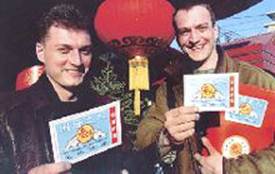
Paul Matulewicz from Poland, Gido Rosler from Germany and their friends send 10,000 greeting cards to ordinary Beijingers during the spring festival.
The phrase "lao wai" is often used by Chinese in daily conversation. Some foreigners wish they'd stop doing it. They suggest "lao wai" is too often employed as a sarcastic, condescending abbreviation of foreigners in China.
When laughing strangers shout at foreigners in the distance, obviously they need urgent reeducation, regardless of their choice of words. But taken out of this context, can "lao wai" be considered in and of itself insulting? And if - wrongly or rightly - the phrase upsets foreigners, then should Chinese retire the popular phrase?
Li Xingjian, editor-in-chief of Chinese Standard Dictionary
Many of these words came into being under special historic circumstances. There were few foreigners in China at the beginning of opening and reform at the end of 1970s. At that time, Chinese often surrounded them and watched.
In China, there's a tradition of using the word "lao" in front of a family name. Thus Chinese dubbed foreigners "lao wai". The word wasn't too reverent or serious originally. But along with China's development and communication with other countries, a growing number of foreigners have come to China. And Chinese aren't so surprised by foreign people anymore.
Chinese and foreigners have gradually befriended each other. The meaning of words evolves over time. And now it's very common to say "lao wai" during our daily life. The meaning of the word often embodies an emotion during some special period.
A word has a derogatory aspect if people speak it with a subjective disrespect. But along with this evolution in the Chinese attitude toward foreigners, the meaning of the word "lao wai" has also changed. It's now got a kind of friendly, colloquial, easy feeling. People often use it. But it's still unsuitable in a formal situation.
Gido Rosler, banner designer, student at Capital University of Economics and Business
I asked many foreigners how they feel when Chinese dub them "lao wai". Eighty percent of foreigners don't think 'lao wai' is a good phrase because many Chinese would not say this word in front of them.
I still remember what happened during the activity my friends and I organized, "Lao wai support the Beijing bid for Olympics Games 2008" last year. Many foreigners refused to sign the scroll as they thought the phrase "lao wai" doesn't respect them.
When I told my Chinese friends about foreigners' reactions to the appellation, most of them were surprised as they don't think of it as disrespectful.
I think the key lies in a lack of communication between foreigners and Chinese. Although many foreigners live in Beijing, or in China, they just live alone and seldom have contact with local people in their daily life. So they don't know each other too deeply.
If both sides want to eliminate the misunderstanding, they should make deeper contact, not just on the surface. In terms of Chinese civilization or Chinese people's habits, I think foreigners should see China through the eyes of the Chinese instead of their own eyes. That's why I adopted the title in the banner. I hope more foreigners in Beijing will grow to accept it.
Requested anonymity, A Chinese
There are also some words that create controversy in English. For instance, in a lecture at the beginning of the year, President Bush upset Pakistanis with his casual use of the abbreviation 'Pakis', widely regarded as a derogatory appellation. It's just like a few Americans even today might use the word 'Negro' to describe African-Americans. It's a kind of discrimination to use these words.
But it's different in this case. Although I don't know the true origin of the word "lao wai", it hasn't any disrespectful meaning - literally at least. "Lao" means "old" in English. It's true it can lead to some bad feeling combined with other words in Chinese. But it signals a sort of respect under most circumstances.
For instance, "shi" means "teacher" in English, but Chinese still add "lao" to it. And "wai" is an abbreviation of foreigners. So I don't think "lao wai" has any negative connotation towards foreigners.
D. Christopher Harry, Graduate student of Beijing Language and Culture University and freelance translator
Most Chinese find the term "lao wai" funny while most foreigners find it "annoying".
Just imagine if you lived outside of China and people often laughed or pointed at you, and shouted "Chinese, Chinese". Clearly, you might find this behavior irritating and unfriendly. Not surprisingly, that is exactly how most foreigners feel in China.
My own extensive research, including surveys in both Chinese and English, demonstrates that the term "lao wai" creates needless cultural conflict and poses a barrier to friendlier and more harmonious relations between Chinese and foreigners.
Most foreigners feel that the term is either too casual, disrespectful or annoying. Almost one-fourth of foreigners I interviewed even feel that the term is an expression of Chinese nationalism.
On the whole, Chinese are very open, friendly and generous toward foreigners. Unfortunately "lao wai" and its usage damages the image of Chinese people among foreigners because it makes Chinese people appear xenophobic and uncivilized. This is because it is considered rude to emphasize that others are "outsiders" in many countries.
I personally feel that one should always treat strangers, especially foreigners, with respect. Most Chinese and foreigners agree, however, that "lao wai" is not a term of respect.
Paul Matulewicz from Poland, Gido Rosler from Germany and their friends send 10,000 greeting cards to ordinary Beijingers during the spring festival.
(Beijing Today March 29, 2002)
Beijing Today
Friday February 8/15,2002
Student group sends defiant `lao wai pride message to city
By Sun Ming/ Su Wei
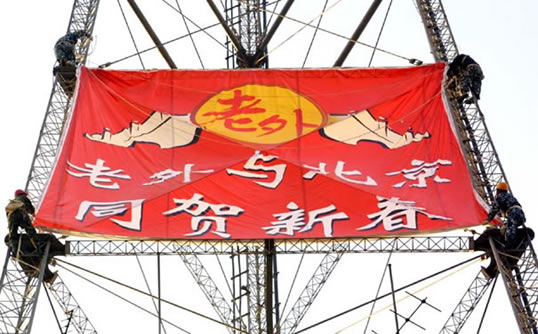
„Foreigners wish Beijingers a happy new year“ declares the red banner atop a CCTV transmission tower in Beijing Yuetan Park.
This 8-metre-long, 9-metre-wide message with white characters was posted to the city on Sunday by a group of 32 foreigners , mainly students , from 11 countries including the USA, Germany, Poland , Canada, Italy and Newsealand.
Banner designer and organizer of the activity Guido Roesler said the group wants to extend its blessings to the Chinese for the upcoming traditional holiday.
“I hope to call on more people to devote themselves to cultural communication among different nations,” said Rosler , a German student of Capital University of Economics and Business.
“We (foreigners) are cultural ambassadors,” he said.
The Chinese characters “lao wai” (“old outsider”, perhaps most literally) are written in a bridge in the banner. Roesler delights in being a “Lao Wai ”a lable sometimes said to be demeaning to foreigners. “Eighty percent of foreigners don’t think `lao wa i`is a good phrase because many Chinese would not say this word in front of them . They think that word does not show respect to them.” People should neutralize this word.” he said. “in addition , in terms of Chinese civilization or Chinese people`s habits I think foreigners should see China through the eyes of the Chinese instead of their own eyes.” Roesler said that was why he had adopted the title in the banner .” I hope more foreigners in Beijing will grow to accept it.” The two ends of the bridge stand for western and eastern culture , he explained.
Sunday`s activity is the first of several planned to strengthen communication and culture exchange between foreigners and Chinese organized by Roesler and his friends. Last year they initiated “Foreigners support Beijing´s Bid and collected 12,008 signatures from more than 100 countries.
The group has also sent 10,000 New Year cards to ordinary Beijingers . The cards also designed by Roesler, have the same content as the banner , except that an extra line of Chinese characters appears above the bridge : “guojiyouren”
(international friends) .
Rosler said he regrets, they can`t send New Year cards to every Beijinger. He and his friends waded through Chinese telephone books choosing the places that they believe best represent ordaniary people: universities, companies and hospitals. “We are grateful to the many Chinese friends that helped us write and send so many cards ,”said Roesler.
“Without their help , it would be impossible for us to do the big job.”
Ask how much it all cost, Roesler refused to answer .” I don`t want you to write that,” he said. Roesler stressed all money involved was raised by themselves .” I don`t want people to think we are for money. We are non-political and non-corporate . “All we have done comes from the heart.”
